Guide 05 UK rural life
Village traditions in England
Many English village traditions grew from the farming year or from the church calendar, and some are far older. This guide looks at the village fete, harvest and May Day customs, well dressing and wassailing, and why communities keep them going.
What a village tradition is
A village tradition is a custom that a community repeats, often once a year, and that gives people a reason to meet. Some have written records going back centuries and others began in living memory. Both count. What matters is that the local people take part and pass the custom on.
Because villages differ, so do their customs. The same festival can look quite different from one county to the next, and many places have a custom that nobody else does.
The village fete
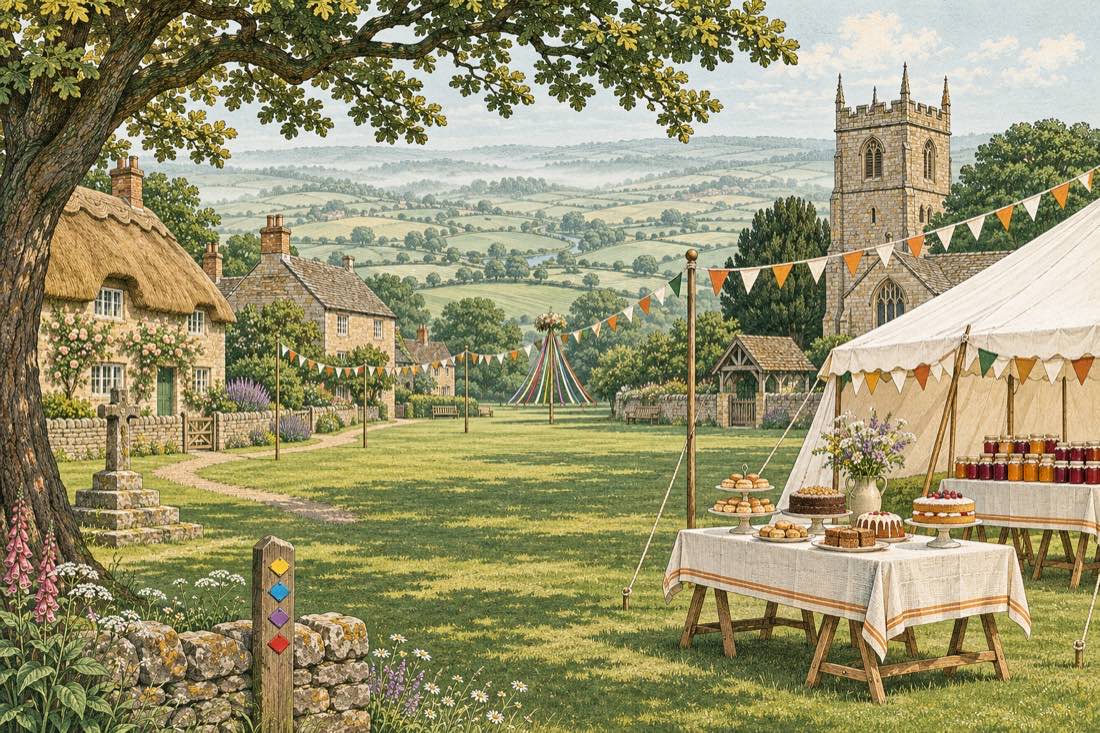
The fete is the best known summer event: stalls of cakes and jam, a tombola, games for children, perhaps a produce tent or a dog show. It is usually organised by volunteers to raise money for the church, the village hall or a local cause. Part of its charm is that it is plainly home-made.
The word comes from French and has long been used for such outdoor gatherings in Britain. Events of this kind remain a mainstay of village life, even in places where the shop or the pub has closed.
Harvest, May Day and the farming year
Harvest festivals mark the gathering of the crops, typically in autumn, and often combine a church service with displays of produce and sometimes a shared meal. May Day customs, such as dancing around a maypole or crowning a May queen, celebrate the arrival of spring and survive in many villages and schools.
Agricultural shows and ploughing matches belong to the same family. They began as a way to share good practice among farmers and now draw a mixed crowd that comes for livestock, crafts and food.
Well dressing and wassailing
Well dressing is a custom found in a number of villages in Derbyshire and nearby counties, where wells and springs are decorated with pictures made from flower petals, moss and other natural materials pressed into wet clay. It is usually held in late spring or summer, and it ties a village to its water.
Wassailing is a winter custom in orchard regions in which people gather in an orchard to make noise, sing and toast the trees in the hope of a good crop. It was revived in many places in recent decades and is now often a community occasion.
Keeping customs alive
Small villages often depend on a few active volunteers, and a custom can fade when people move away or the hall closes. Where customs do thrive it is usually because the village gives them a home, a date and a task for every age group.
If you visit one, treat it as a local gathering rather than a show: park considerately, stay on public ground and follow the signs. The Countryside Code applies to events as much as walks.