Guide 03 UK rural life
Farming in the UK: types of farm and how land is used
Farming shapes most of what visitors call the countryside. This guide explains the main kinds of farm, why upland and lowland farms differ and how a farm connects to the hedges, fields and footpaths you see.
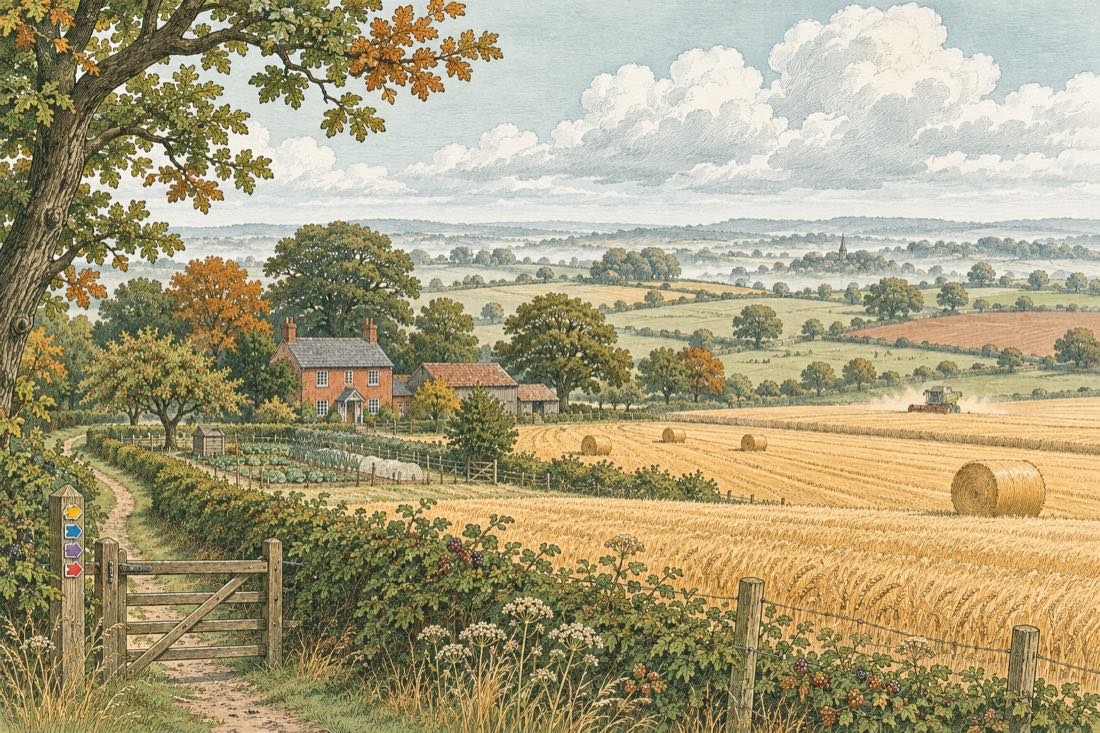
How much of the UK is farmed
Farming is the largest single use of land in the United Kingdom. Government statistics put the utilised agricultural area at about 17 million hectares, which is roughly 70 per cent of UK land. The figure shifts slightly from year to year and excludes woodland, so it describes farmland and rough grazing rather than all green space.
The same statistics show that farming is a large user of land but a small part of the economy by value, which is one reason debates about land often feel bigger than the sector's share of national output.
Arable, livestock and mixed farms
Farm types are usually grouped by what they mainly produce. Arable farms grow crops such as wheat, barley, oilseed rape and potatoes. Livestock farms keep animals: sheep, beef cattle and dairy cows are the best known, with pigs and poultry as further groups. Mixed farms combine crops and animals, and a mixed system lets manure feed the soil and crops feed the animals.
Horticulture, such as vegetables, fruit and flowers, is a smaller but intensive group, often found on lighter soils and near markets.
Upland and lowland
The land itself picks the farming. Flat, deep soils in the east and south of England suit arable crops. The wetter, hillier west and north suit grass, so more of the land carries sheep and cattle. In the hills, poor soil and weather make rough grazing the main option, and hill farms often use open common ground as well as walled fields.
That is why Britain has so many stone walls in the uplands and so many hedges in the lowlands: farmers used the materials at hand to mark fields and keep animals in. The hedgerow guide covers both.
Farms and the landscape
Almost every visible feature of the farmed countryside came from a choice. Field size, hedge lines, barns, ponds and tracks all reflect past farming needs. Public footpaths often follow old routes between villages, fields and markets, which is why they cross farmland so often.
Farming also sits in a web of rules. Agriculture is a devolved matter, so England, Scotland, Wales and Northern Ireland each run their own support schemes, and these increasingly pay for environmental work such as hedge care, buffer strips and habitat as well as for food production.
Why farming is in the news
Farm incomes, weather, input costs, tax rules, trade and imports, animal disease and the way land is managed for nature all appear in news stories. This site does not take a side in those debates. Its aim is to explain how farms work so that the debate is easier to follow, and to leave the arguments to the people and bodies that make them.